
The Hidden Cost of a Missing IFSC Code
Ramprit Kumar has never heard of an IFSC code.
Why would he? He is a farmer from Samastipur. He grows paddy on less than two acres of land and sells his produce through the local Primary Agricultural Credit Society (PACS). Like millions of farmers across Bihar, he assumes that once his crop is procured and accepted, the payment will reach him quickly.
After all, the grain has been delivered. The paperwork is complete. The money has been approved.
What could possibly delay the payment?
As it turns out, the answer lies not in the fields but in the invisible plumbing of India’s banking system.
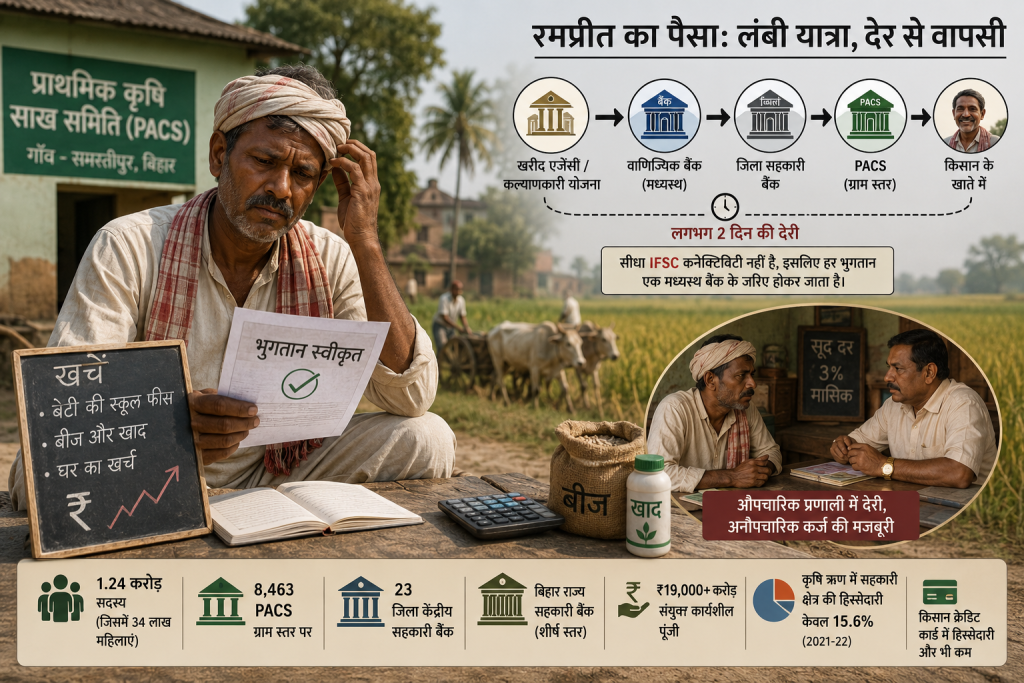
When Ramprit’s paddy was procured, the payment was indeed released. Yet it did not reach him immediately. Instead, it spent nearly two days moving through a chain of banking intermediaries before finally arriving in his account.
For Ramprit, those two days mattered.
His daughter’s school fees were due. The next sowing season required seeds and fertilisers. Household expenses could not wait. So he did what countless farmers have done for generations when formal systems move too slowly—he borrowed money from a local lender at a high rate of interest.
The irony is difficult to miss. The money already belonged to him. Yet he had to borrow because he could not access it.
The Curious Journey of a Farmer’s Money
Why does this happen?
The answer lies in a technical but important issue: many cooperative banks in Bihar do not possess independent IFSC connectivity for direct participation in national payment systems.
An IFSC code is what allows banks to directly send and receive money through systems such as NEFT, RTGS, and IMPS. Without that connectivity, a cooperative bank cannot transfer funds directly. Instead, it must route every transaction through a commercial bank that already has access to the national payments infrastructure.
Imagine owning a water pipeline but not being allowed to connect it directly to the main network. Every drop of water would have to pass through somebody else’s pipe before reaching its destination.
That is essentially what happens to many payments moving through Bihar’s cooperative banking system.
The money begins its journey from procurement agencies or welfare programmes, passes through a commercial bank acting as an intermediary, and only then reaches the cooperative institution and ultimately the farmer. Every additional step creates delays, costs, and inefficiencies.
A Massive Network Running on Borrowed Infrastructure
What makes this issue particularly significant is the scale of Bihar’s cooperative network.
The state’s cooperative structure stretches from the Bihar State Cooperative Bank at the apex to around 23 District Central Cooperative Banks and an extraordinary network of 8,463 PACS operating at the village level.
Together, these institutions serve approximately 1.24 crore members, including nearly 34 lakh women. Their combined working capital exceeds ₹19,000 crore.
In a state where almost nine out of ten people still live in rural areas, these institutions are not peripheral. For many villages, they represent the most accessible form of formal banking.
Yet a network of this magnitude still depends on another bank’s infrastructure to make many of its digital payments.
That raises an important question: if Bihar has successfully built one of the largest grassroots cooperative networks in the country, why has it not been empowered with the digital autonomy required to serve its members efficiently?
The Double Loss
The consequences of this arrangement are felt at two levels.
The first loss is borne by the farmer.
Delayed payments create uncertainty. Even short delays can push households towards informal borrowing. For small farmers operating on narrow margins, a few days can mean additional interest costs, postponed investments, and financial stress.
The second loss is borne by the cooperative institutions themselves.
When funds remain parked in transit or suspense accounts, the cooperative system loses the opportunity to earn interest on those amounts. At the same time, routing transactions through intermediary banks often involves technical and service charges, increasing operational expenses.
In effect, both the institution and the farmer pay a price for a problem neither created.
The only winner is the informal lender who steps in when the formal system is unable to deliver quickly enough.
A Bigger Question About Rural Credit
The impact of these inefficiencies becomes visible in Bihar’s agricultural credit landscape.
Despite its extensive reach and deep village presence, the cooperative sector accounted for only about 15.6 percent of agricultural lending in Bihar in 2021-22. Its share in issuing Kisan Credit Cards was even lower.
These numbers tell a larger story.
Bihar’s cooperative network has scale. It has trust. It has proximity to farmers. What it often lacks is the technological and institutional capacity to fully utilise those strengths.
When a system serving over a crore members performs below its potential, the issue is not merely administrative. It becomes a development challenge.
Beyond Banking, Towards Rural Transformation
At first glance, an IFSC code may seem like a technical detail that concerns only bankers and regulators.
But Ramprit’s story reminds us that technology and governance are never truly abstract. Behind every delayed transaction is a farmer waiting for payment. Behind every inefficiency is a family adjusting its plans. Behind every institutional bottleneck is a missed opportunity for rural prosperity.
Bihar has already built the network.
The villages are connected. The institutions exist. The trust has been earned over decades.
The question now is whether the state can modernize the infrastructure that supports this network.
Because when money takes the long road home, development does too.
And perhaps the future of Bihar’s rural economy depends not only on how much money flows into villages, but also on how quickly it reaches the people who have earned it.
- Neelabh Kumar Sharma is an Assistant Director at the Centre for Human Sciences, Rishihood University